Jeju Wasabi: Filling the Global Supply Gap
Collapse of the Traditional Wasabi Cultivation Model Under Climate Change
For decades, the Japanese wasabi industry has relied on doradadami, a traditional cultivation method using natural spring water flowing through terraced fields. This system historically delivered exceptional quality due to ideal natural water flow, temperature, and geology. However, over the past decade, accelerating climate change has exposed critical vulnerabilities. Japan’s wasabi production has reportedly fallen by approximately 55%, driven by rising water temperatures, decreasing spring flow, altered rainfall patterns, and increased disease pressure.
Supply Declines vs. Rising Global Demand
While supply is shrinking, demand continues to grow. In Japan, the expansion of omakase and premium sushi restaurants, the premiumization of the HMR market, and convenience-store luxury product lines have boosted consumption. Across East Asia—Korea, Singapore, Taiwan—high-end dining trends are similarly increasing wasabi demand. In Europe and North America, markets once dominated by “substitutes” (horseradish blends) are showing rapid growth in interest for authentic real wasabi.
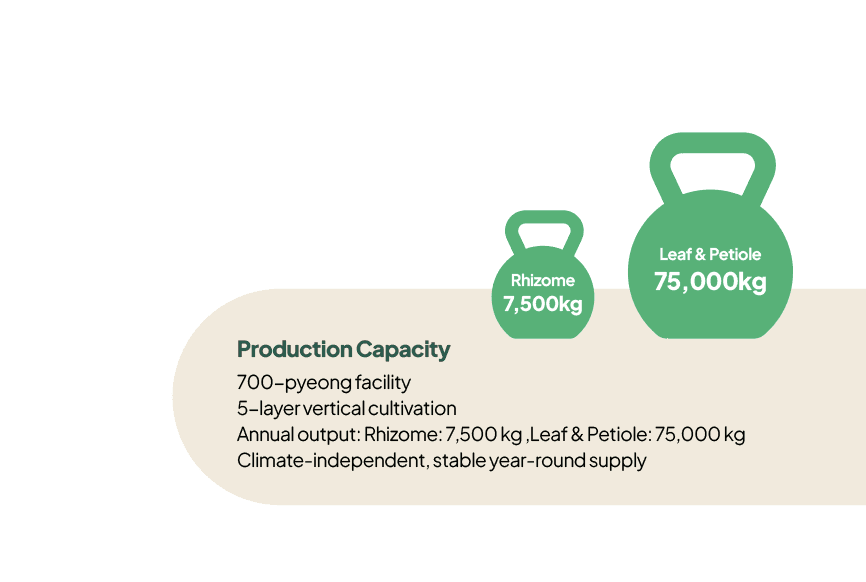
This global imbalance—falling supply and rising demand—means that traditional cultivation can no longer satisfy the market. Moreover, climate change cannot be solved simply by relocating farms, making a climate-independent, technology-based production model essential. Jeju Wasabi is positioned as a new alternative supplier capable of filling the global supply gap.
Author
Category
A Global Market Defined by Declining Supply and Rising Demand
Expansion Potential Across Japan, East Asia, Europe, and North America
The global wasabi market is experiencing a structural imbalance in which supply continues to decline while demand expands across multiple regions. This shift is opening new opportunities for alternative production centers capable of delivering consistent, high-quality wasabi.
1. Japan: Declining Domestic Production and Expanding High-End Consumption
Japan’s wasabi production has fallen dramatically over the past two decades.
According to the Ministry of Agriculture, Forestry and Fisheries of Japan, output decreased from 4,614.5 tons in 2005 to 1,885.5 tons in 2021—a reduction to roughly one-third of previous levels.
This decline is attributed to rising water temperatures, reduced spring flow, altered rainfall patterns, and increased disease pressure caused by climate change.
Meanwhile, demand continues to rise:
Growth of the omakase and premium sushi dining sectors
Expansion of Japan’s high-end HMR (Home Meal Replacement) market
Launch of premium product lines in convenience stores
These trends indicate ongoing market growth despite falling domestic production.
2. East Asia: Rapid Growth of Premium Food Culture
Across Korea, Taiwan, Singapore, and Hong Kong, the rise of premium sushi and Japanese dining has driven consistent growth in wasabi consumption.
Most of these markets still rely heavily on Japanese imports, creating a strong opportunity for Jeju Wasabi as a reliable alternative supplier with stable year-round production.
Korea’s import data further supports this trend:
In 2021, the country imported approximately 7 tons of Japanese wasabi (fresh, frozen, dried, and leafy variants combined), totaling USD 1,531,905 in import value.
Increasing imports indicate that the domestic market is shifting toward higher-quality, authentic wasabi products.
3. Europe and North America: Shift From Substitutes to Real Wasabi
Historically, restaurants in Europe and North America have used horseradish-based substitutes containing mustard powder, food coloring, and artificial flavoring.
However, as upscale Asian cuisine continues to expand, demand for authentic real wasabi is rising steadily.
Premium restaurants in cities such as London, Paris, New York, Vancouver, and Los Angeles are actively seeking stable suppliers capable of offering authentic flavor profiles, traceability, and clean-label production—areas where Jeju Wasabi holds strong competitive advantages.
4. A Global Supply Gap Creates an Opportunity for Jeju Wasabi
The combination of shrinking Japanese production and expanding global culinary demand forms a clear supply gap in the market.
Jeju Wasabi, supported by JD Tech’s technology-driven and climate-independent cultivation system, is positioned to emerge as a reliable, scalable, and sustainable alternative supply source.
Its ability to maintain consistent quality, ensure year-round production, and meet international safety standards makes it well-suited for rapid expansion into Japan, East Asia, Europe, and North America.